How to work effectively with AI agents: 7 rules that save you time and money
An AI agent is not a magical employee that "knows everything". It is a tool that gives huge leverage — if you set it up right. Here are the rules we apply in every deployment.
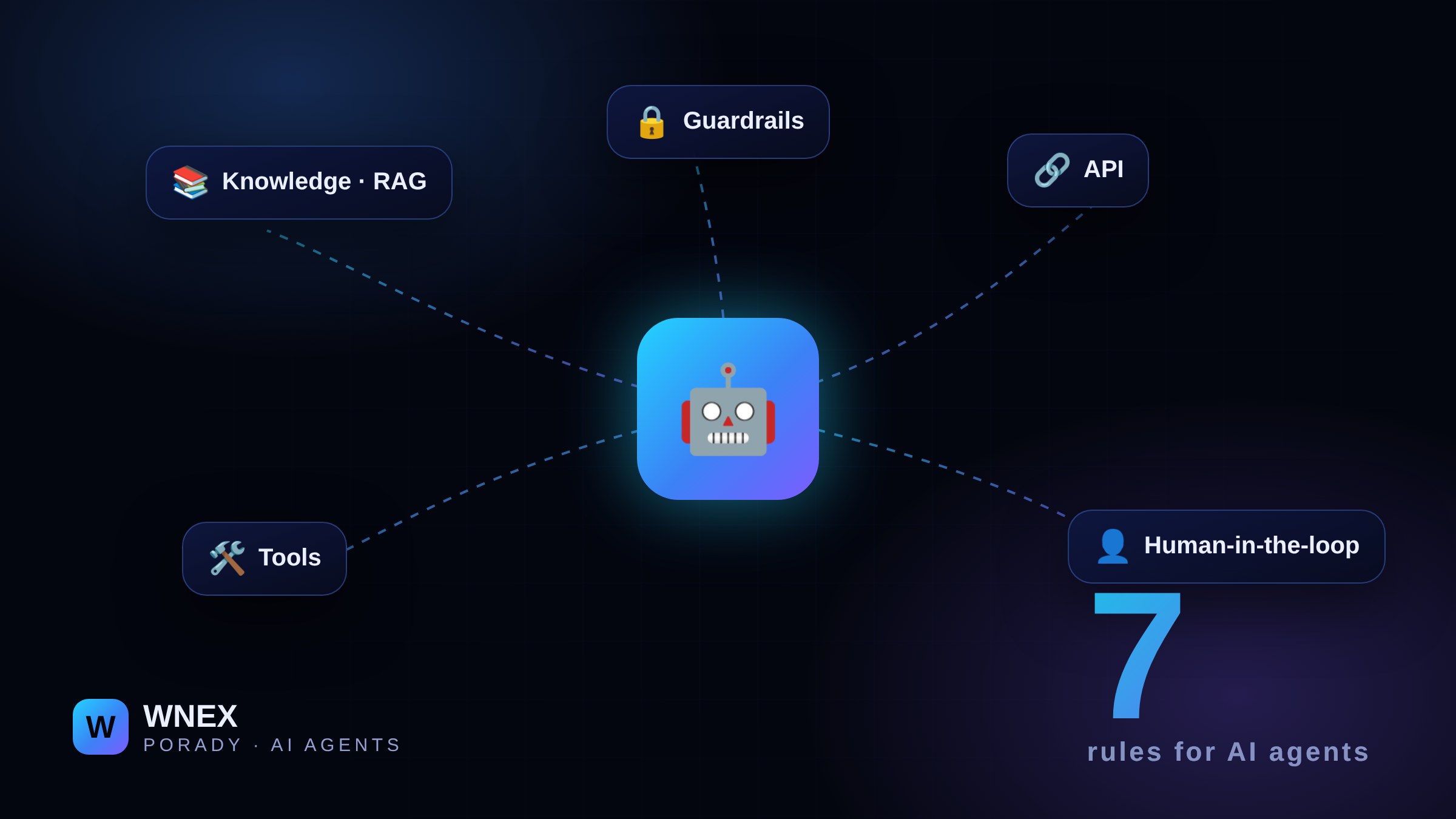
Today AI agents can serve customers, search through documents, fill in systems and make simple decisions — on their own, around the clock. But there is a gulf between an "interesting demo" and a solution that actually earns or saves money. The difference almost never lies in the model itself. It lies in how you work with it.
Below are the seven rules we apply in every AI agent deployment for our clients.
1. Start with one narrow task
The biggest mistake is asking to "build us an agent that handles all of customer service". An agent that is supposed to do everything does nothing well — it is hard to test, evaluate and improve.
Pick one repeatable, well-defined task: answering order-status questions, qualifying a lead from a form, summarizing tickets. Get it to perfection, measure the effect, and only then expand the scope. A narrow agent that works reliably is worth more than a broad one you cannot trust.
2. Context is the agent's fuel
A language model does not know your company. It does not know your return policy, how much an implementation costs, or that "Project Orion" is an internal name. Answer quality depends directly on the context you give it.
In practice this means connecting a knowledge base: documents, FAQs, price lists, conversation history. For a small amount of knowledge it is enough to inject it into the agent's instructions. For more, you use RAG (retrieval-augmented generation) — the agent retrieves the right fragment and answers based on it instead of guessing. The rule is simple: the better the context, the fewer hallucinations.
3. Give the agent tools, not just conversation
An agent that can only "talk" is a better chatbot. The real value appears when you give it tools (function calling): checking an order status in the database, creating a ticket in the CRM, sending an email, calling an external API.
A well-designed agent does not "pretend" it did something — it actually performs the action in your system and reports the result. That is exactly what separates an agent from a plain text generator.
4. Keep a human in the loop
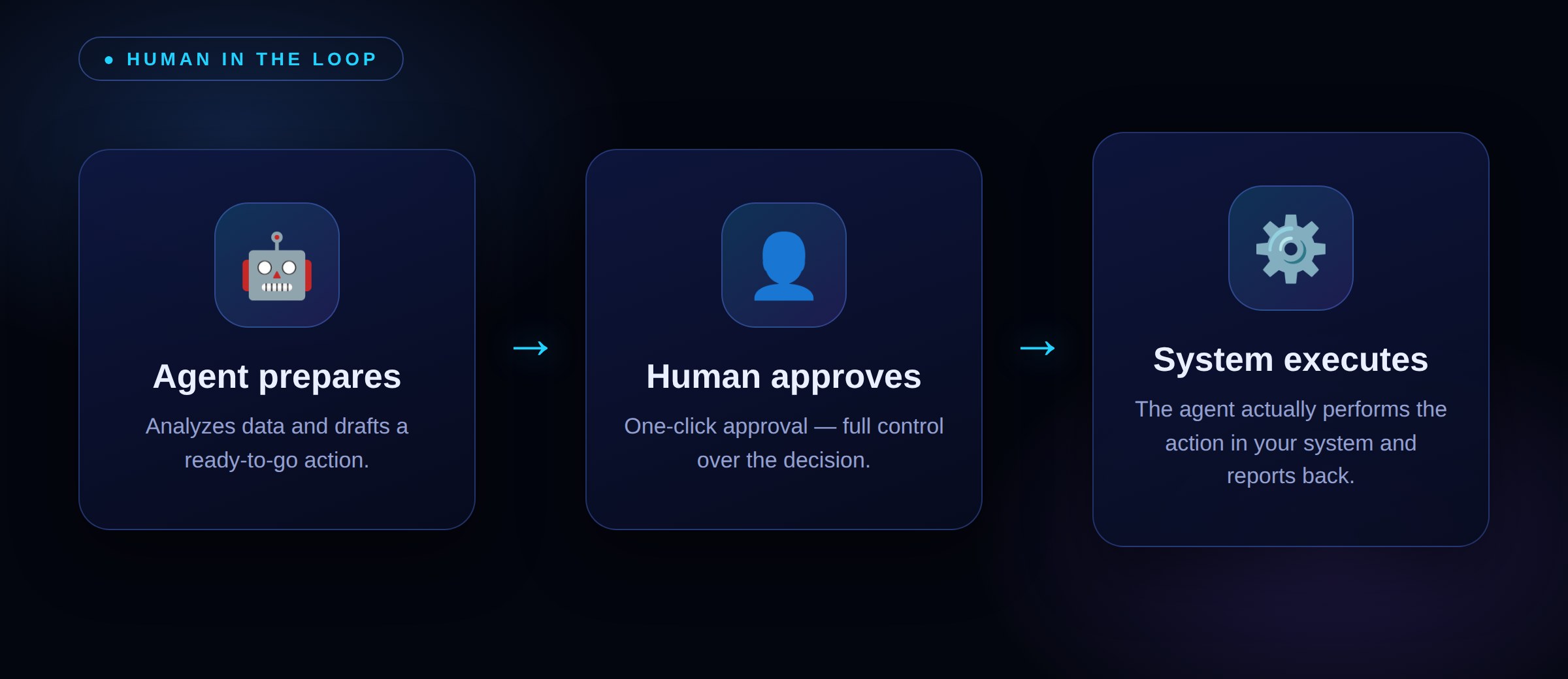
Not every decision should be fully automatic. For irreversible or costly actions — sending an offer, issuing a refund, changing customer data — it is worth adding a human approval step.
A good pattern is: the agent prepares, the human approves with a single click. You gain the speed of automation while keeping control. Over time, as trust in the agent grows and you have data confirming its effectiveness, you can deliberately push the automation boundary further.
5. Guardrails and data security
An agent connected to your systems is also a new surface of risk. Three things to take care of from day one:
- Scope — the agent should refuse tasks outside its role instead of improvising. Clear instructions and guardrails keep it on topic.
- Data — API keys never reach the user's browser; model calls go through the backend. Sensitive data is filtered before being sent to the model.
- Limits — rate-limiting and cost caps protect against abuse and an unexpected bill.
6. Measure, then scale
"It seems to work" is not a metric. Before you call a deployment a success, decide what you measure: the share of cases resolved without a human, response time, cost per conversation, customer satisfaction.
Log conversations and review them regularly — it is the fastest way to find where the agent goes wrong and fix the instructions or the knowledge base. An AI deployment is not a "build it and forget it" project, but a cycle: measure → improve → repeat.
7. Match the model to the task (and don't overpay)
Not every task needs the most expensive, most powerful model. Simple classification or short answers work great on fast, cheap (often free) models. Reserve the strongest models for tasks that truly require them — complex reasoning or analysis of long documents.
A well-designed architecture lets you swap the model without rewriting the application — cheaper today, more powerful tomorrow, depending on your needs and budget. It is one of the first things we ask about when designing a solution.
Summary
An effective AI agent is not a matter of a "better prompt", but of good engineering: a narrow scope, solid context, real tools, a human in the loop where needed, security, measurement and a sensible choice of model. Do it right and the agent becomes one of the most cost-effective workers in your company — one that never sleeps, never forgets and scales along with you.
Want to bring AI into your company?
We'll help design and launch an AI solution tailored to your processes.
Let's talk